
Home > 3,000 Years in Eight Strokes: A Brief History of Chinese Script
3,000 Years in Eight Strokes: A Brief History of Chinese Script
TRENDING
3,000 Years in Eight Strokes: A Brief History of Chinese Script
From bones burned in ancient fires to the screen you're reading right now — how Chinese writing survived, transformed, and took over the world.
Most writing systems start with a moment — a spark, a need, a breakthrough. Chinese writing is different. It didn't arrive fully formed. It grew, survived empires, weathered wars, got standardized by a tyrant, copied by neighboring civilizations, simplified by a revolution, and somehow ended up on your phone. That three-thousand-year journey is one of the most remarkable stories in human history. And it starts with a pile of bones mistaken for dragon medicine.
We're going to move through eight key stages in the life of Chinese script — not as a dry history lesson, but as a story of people under pressure, making decisions that still shape how over a billion people write today. Each stage left its mark on the characters you'd find in a Chinese newspaper, on a storefront in Singapore, or in a centuries-old poem hanging in a museum.
Stage 1: Oracle Bone Script — Writing Born from Fire
c. 1250–1046 BCE · Dynasty: Shang · Material: Turtle shells & ox bones · Purpose: Royal divination
If you've read our earlier blog piece "Written in Fire and Bone," you already know this story begins with dragon bones and a scholar with a sharp eye. But let's look at Oracle Bone Script as a writing system, not just a discovery.
The Shang kings used inscribed shells and bones to communicate with their ancestors and gods — asking about harvests, battles, weather, and royal births. A diviner would carve the question into the bone, apply heat, and read the resulting cracks as a divine answer. The question, and sometimes the outcome, were then carved as a permanent record.
What's remarkable is how purposeful these early characters already were. Scholars have identified over 4,000 distinct Oracle Bone characters, of which roughly 1,500 have been confidently decoded. Many are recognizable ancestors of characters still used today — simplified and streamlined over the centuries, but unmistakably related.
All six of these characters existed in recognizable form on Oracle Bones over 3,000 years ago.
Stage 2: Bronze Script — Writing Cast in Metal
c. 1100–221 BCE · Dynasty: Zhou · Material: Cast bronze vessels · Purpose: Commemorative records
As the Shang Dynasty gave way to the Zhou, writing moved off bones and onto bronze. Ritual vessels — massive, ornate cauldrons and bells used in ceremonies — were inscribed with records of royal gifts, military victories, and noble appointments.
The move to metal changed the look of the script. Because characters were cast rather than scratched, they became slightly rounder and more elaborate — the ancient equivalent of switching from a pencil to a calligraphy pen. This was also the period when Chinese writing began to spread beyond the royal court, carried by administrators, merchants, and scholars moving between regions. Writing was becoming not just a royal tool, but a cultural one.
Stage 3: Seal Script — When a Tyrant Unified the Written Word
221–206 BCE · Dynasty: Qin · Key figure: Emperor Qin Shi Huang · Achievement: First national standardization of script
By the time China's Warring States period ended — a brutal few centuries of fragmented kingdoms fighting for dominance — Chinese writing had developed into dozens of regional variants. Different states used different forms of the same characters. A merchant from one kingdom couldn't easily read documents from another.
Enter Qin Shi Huang, the first emperor to unify China in 221 BCE. Ruthless, visionary, and obsessed with control, he standardized everything — weights, measures, axle widths, laws, and crucially, writing. His chancellor Li Si oversaw the creation of Small Seal Script (小篆): tidier, more symmetrical, and officially mandated across the entire empire.
Stage 4: Clerical Script — When Bureaucrats Sped Things Up
206 BCE – 220 CE · Dynasty: Han · Driven by: Administrative need for speed · Legacy: The ancestor of all modern script styles
Seal Script was elegant — but slow to write. Running a vast empire generates enormous amounts of paperwork, and government clerks writing all day didn't have time for beautifully curved, perfectly symmetrical characters. So they developed shortcuts.
Clerical Script (隶书, Lìshū) flattened the curves of Seal Script into crisp angles and added the distinctive sweeping horizontal strokes still visible in formal Chinese calligraphy today. This is the moment Chinese writing crossed what scholars call the "ancient-to-modern" divide. If you placed Clerical Script beside a modern Chinese newspaper, you'd see an unmistakable family resemblance.
Stage 5: Regular Script — The Form That Conquered Everything
220 CE – Present · Period: Late Han through Tang Dynasty and beyond · Status: The standard written form used to this day
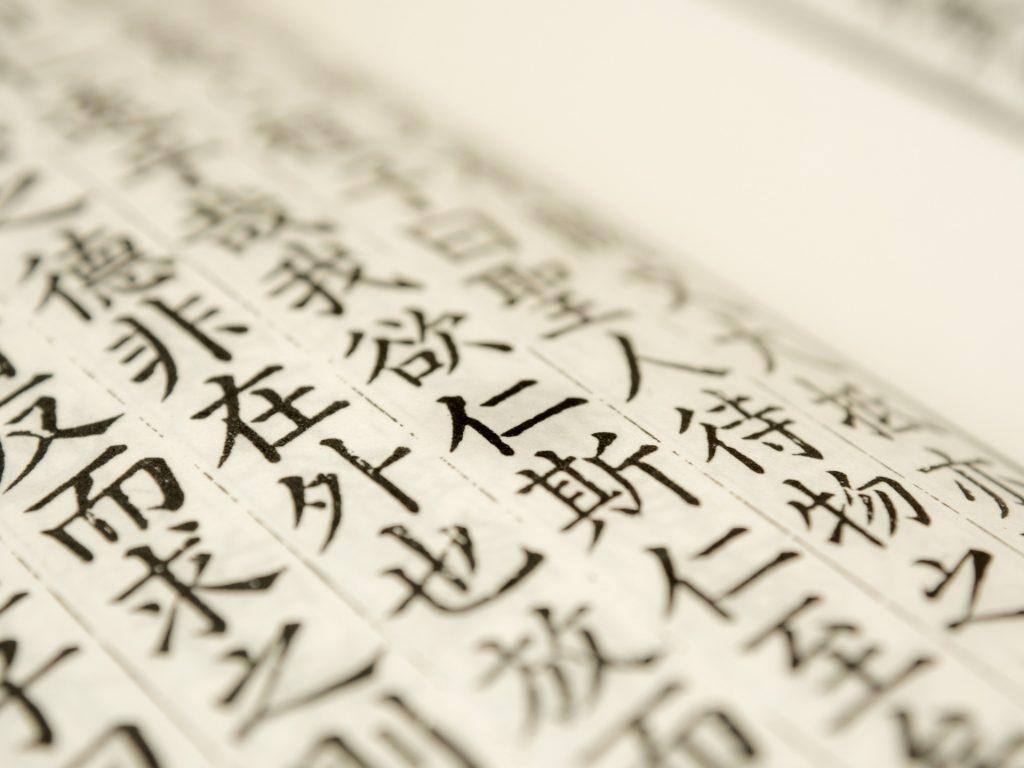
Out of Clerical Script grew Regular Script (楷书, Kǎishū) — and this is the form that has endured. Regular Script is what you see in printed books, textbooks, newspapers, and on signage across the Chinese-speaking world. It's what children learn first in school, and the benchmark against which all other forms of Chinese writing are measured.
What makes Regular Script so lasting? It strikes a perfect balance. Strokes are clear and distinct — no ambiguity about where one ends and another begins. Characters fit neatly into a square frame, making them easy to typeset, print, and digitize. After centuries of refinement through the Tang Dynasty — widely considered the golden age of Chinese calligraphy — the proportions and stroke sequences became codified into a standard that millions of teachers have passed to millions of students ever since.
Regular Script is the foundation of everything The Trio System teaches. When you learn a character using the Bridge and Memory Jogger method, you're learning it in its most essential, functional, and lasting form — the same form refined by a thousand years of calligraphers and now encoded into every Chinese-language device on earth.
Stage 6: Running & Cursive Script — Writing for Speed and Soul
300s–700s CE · Purpose: Everyday handwriting & artistic expression · Status: Still practiced in calligraphy today
Alongside Regular Script, two expressive cousins developed. Running Script (行书) is like Regular Script written at a natural, comfortable pace — strokes connect slightly, corners round off, and characters flow more easily from the brush. Most educated Chinese people use something close to Running Script when writing by hand today.
Cursive Script (草书, Cǎoshū) takes this freedom to its extreme. Strokes are dramatically abbreviated, characters blur together, and the result can look almost abstract to the uninitiated. Cursive Script is the jazz of Chinese writing — built on a deep knowledge of the rules, then gloriously improvised. For learners, it's enough to know these forms exist and that the same character can look very different depending on context.
Stage 7: Simplified Characters — A Revolution on Paper
1956–1964 · Introduced by: People's Republic of China · Goal: Reduce illiteracy · Used in: Mainland China, Singapore, Malaysia
In the mid-twentieth century, the People's Republic of China systematically simplified hundreds of the most complex characters — reducing stroke counts, merging similar forms, and standardizing variants — to make reading and writing faster and easier to learn. The result was Simplified Chinese (简体字), officially rolled out in 1956 and 1964.
Traditional Chinese (繁體字) continued to be used in Taiwan, Hong Kong, Macau, and among many overseas Chinese communities. Neither form is more "correct" than the other — they are two branches of the same living tree, shaped by different political and cultural histories. We'll take a much deeper look at the split in Post 1.4.
Same pronunciation, same meaning — different visual form. The logic underneath remains identical.
Stage 8: The Digital Age — Ancient Script, Modern Screen
1990s – Present · Challenge: Typing thousands of characters on a 26-key keyboard · Solution: Pinyin input & Unicode
The final stage in our journey is happening right now. How do you type a writing system with thousands of characters on a keyboard built for 26 letters? The answer — called Pinyin input — uses the Roman alphabet to phonetically spell out how a character sounds, then offers a menu of matching characters to choose from. Type "ai" and up pop 爱, 挨, 哀, and dozens more. Select the one you mean.
The result is that Chinese writing — born on bones in ancient fires — now flows through smartphones, messaging apps, and social media with the same ease as any alphabetic language. Characters carved by hand more than three thousand years ago are rendered in milliseconds on screens around the world. That's not just survival. That's dominance.
Three Thousand Years. Still Writing.
What's astonishing about this history isn't just how old Chinese writing is. It's how unbroken the thread is. A scholar today studying Oracle Bone Script can trace a direct, continuous line from those ancient carvings to a WeChat message sent this morning. No other writing system on Earth can claim that kind of continuity at that kind of scale.
Chinese writing survived because it was useful — practical, adaptable, and deeply embedded in culture. It was standardized when fragmentation threatened it, simplified when literacy demanded it, and digitized when the world moved online. At every pressure point in history, it bent rather than broke.
In our next post, we'll go one level deeper: how are individual Chinese characters actually built? You'll learn about radicals, phonetic families, and the hidden logic that makes the system — once you truly see it — genuinely hard to forget.
History Is the Reason the Method Works
Every stage of this history refined Chinese characters toward their most efficient, learnable form. The Trio System works with Regular Script — the final, enduring form — and uses radicals (the building blocks that persisted through every era) as the key to unlocking the whole system. Understanding this history isn't just background. It's the reason the method is built the way it is.
How a Chinese Character Is Built: Radicals, Roots & Logic
The secret system hiding inside every character — once you see it, you can't unsee it. We break down exactly how Chinese characters are constructed and why it makes the whole system far more learnable than you think.
Read the Next Post →